
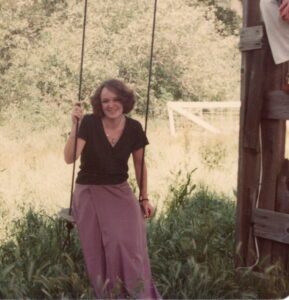
 I really had each foot in a different musical tradition in the early 1980’s.
As you may have read in my last blog, I was deeply steeped in singing with the Sufi Choir, which had its genesis in both western and eastern mysticism, both the Vedantic traditions (think: Hindu, Sikh, basically east Indian) and that of Islam, the sects which believe in love and brotherhood and evidence that through poetry and music, particularly singing. This was up in Sonoma County, mostly Sebastopol. I had also begun attending a “zikr” meeting, which is chanting sung to beautiful melodies with the aim to remember Divinity and try for a closer relationship with that Being, that Heart, that Intelligence. Become one, if possible, with it. These meetings were in San Rafael, which was twenty-two miles south of my (communal) home in Petaluma, and the choir met seventeen miles northwest of there.
I began my voice lessons with Judy Davis (Barbra Steisand’s west coast vocal coach; she of course had a main one in NYC) in Oakland, which was forty-four miles from Petaluma, once a week. I was truly a traveling singer, driving over 150 miles a week, though all of it was by choice, not profession. I was also a full-time self-employed tax and bookkeeping professional. I cannot believe now that I kept this lifestyle going, but I was in my early thirties and had at least two to three times my current energy level.
In Judy’s dimly lit studio, I was surprised to find that there were only a handful of us. Ten at most, and my recollection is that not everyone who was there the first time continued; there were only five or six who hung on. But even if she did this half-time I figured she was making a good living, perhaps several thousand dollars a week. We did go around the room and introduce ourselves; three of the men were Sammy Hagar’s musicians, his two guitarists and one drummer, and another woman was someone who was regularly singing in nightclubs. I was the only one not being paid for performing. I wasn’t sure if this meant I was a laggard or lucky.
Judy’s background was that she had been slated for a singing career but at one point in the distant past she’d had her tonsils out and the medical team dropped ether on her vocal cords, ruining her voice. She sounded like a heavy smoker, hoarse, but was adamantly against cigarettes as they do the most damage to the throat. In her research she’d found that alcohol and then citrus, especially lemon, were the next most damaging substances to the natural lubrication of the throat and vocal cords. She said that it took twenty-four hours for the throat to recover from those liquids. She decided to dedicate herself to teaching others to sing. I thought this was almost saintly, given she could have been devastated by the mistake that ruined her natural talent.
She gave us each a tape (yes, a cassette, that’s what we used back in the covered wagon days of the 1980’s) of vocal practices and went over them with us. We were to do the beginning ones repeatedly for at least 30 minutes a day and wait until we were advanced to do some of the others on the tape. One of them, for instance, was to sing the word “hee” on a series of descending notes she played on the piano, with as long an outbreath as possible, holding the note as long as possible. In the class and on the tape, she’d say, “Hee down,” play a note, and you’d sing down the scale four notes, hold the last note, then go to the next beginning note starting with a fresh “hee.” She also gave us breath exercises to do, to increase our lung capacity. I remember one as bending forward at the waist and panting.
Since two of Sammy’s guys lived up my way, we began commuting to lessons together and enjoyed a lot of fun banter during the two commuting hours we spent together once a week. Here are the only conversations I remember:
Once as we went around a corner past a café with outdoor tables, one of the guitarists, Bill, noted, “Wow, did you see that beautiful woman? She was picking her nose there at that table while she was having her coffee and reading a book. A human woman.” This impressed me because it seemed he didn’t hold the nose-picking against her.
Another time the conversation was about not smoking cigarettes, but that maybe we smoked a little pot sometimes… and Bill, referring to our driver, the other guitarist, said, “Gary doesn’t even chew gum!” which elicited a chuckle from Gary. Gary was, despite being a heavy rocker, a very health-conscious man, pure vegetarian diet, and no substances.
The only thing I remember Chuck, the drummer, saying, at one of our lessons in the studio, was “Did everybody do your Hugh Downs?” (Hugh Downs was a famous TV host, from “The Jack Paar Show,” “Today,” and “Concentration.” Hee downs, Hugh Downs.)
Judy was going for a buzz in our sound—really, it could tickle your nose and throat—and no vibrato; she said the vibrato would come naturally and be prettier after we held a note a long time, not to ever try to make it happen on purpose. She’d have each of us do all the exercises each time in front of the group and have us repeat them until we could hear the sound she was going for, which would improve our pitch and our ability to hold a note. And once again we weren’t supposed to talk because she wanted us to hear the other voices and hear what good singing was and what was not.
We also had to learn some old standards: “Blue Moon,” “Moonlight in Vermont,” and others, while exaggerating the sounds of the vowels, pronounced eh, ee, ah, oh and oo. “I” was pronounced “ah-ee.” If we were ever to sing these songs in performance, we were to forget all of that and just sing them normally and they’d be better than they had been before we learned how to “really” do vowels.
My voice definitely did improve, and some of the Sufi teachers noticed.
At least once a week, I was singing with Vasheest Phil Davenport (mentioned in two prior blogs) at his zikr meetings, and he was teaching me to lead parts for the women’s voices. The participants stood or walked in a circle and the lead singers and any guitarist or drummer (playing the soft, hand-held tar) stood in the center. Because of my development there, three other Sufi teachers who also led zikr meetings from various Sufi traditions—Turkish whirling dervishes, the Mevlevi Order that came out of the tradition of the mystic poet Rumi; another that came from a Pakistani tradition; and another with completely American roots—asked me to sing in the center of their circles and solo with improvised chanting over the voices of the circle. I was humbled to be doing this, but it partly came about because it was difficult for me to stand for more than a few minutes, and I needed to sit down periodically. So Vasheest had said to sit in the center of the circle rather than outside, and then had me start singing, sometimes improvising a solo.
Vasheest also wanted to start up some weekend workshops employing some of the psychological kinds of “processing” used in programs like Life Spring for all of us to get to know each other better and try and let go of some of the mental and emotional baggage people tend to take on. So, I began helping him organize these and was spending at least one weekend a month at the Sufi house in San Rafael, Marin County: sometimes two or three a month. We’d bring perhaps twenty people together and spend the weekend at the house there, chanting, praying, talking, trying to go deeper into who we were and wanted to be.
At my best, when singing especially a solo in any of the zikr circles, I would go into a deep state of love and inspiration and my voice reflected this. People told me it took them to a place of profound love and unity at times. But a friend told me that this “position” led others to some jealousy, saying, “Why does she get to be in the center?” I think some thought it was because I oversaw the Sufis’ financial work for a number of years, but the two experiences were in no way related. I realized that I didn’t want to tread the path of a Sufi teacher, which I thought would lead to others thinking I thought I was, I don’t know, superior or something. All I wanted to do was sing, and harmonize with the other voices, and bring ecstatic music into the room.
In the spring of 1982, I moved to Marin County to be closer to the volunteer work I was doing with Vasheest (no one was getting paid, this was all for love of music, God and each other) and also closer to my lessons with Mrs. Davis, cutting down some of the hours I’d been spending on the freeway. Vasheest soon decided to put together a journey of Sufi’s to India and the middle east, and I began putting things in place to be able to leave my established life (and my dog, Mollie, and my cat, Dharma) for three months.
I continued with my voice lessons for a few more months but had to bid Judy Davis and the rock and roll guys goodbye when I took off on several long flights to India, via New York and Pakistan, in September. I didn’t know if I’d be able to continue my lessons, and it had slowly dawned on me that if I wanted to get even a job as a backup singer for someone prominent enough to offer full time singing employment, I’d have to put in my time (more honestly, pay my dues) singing in bars and clubs. That’s how you get experience, that’s how you get exposure or discovered, that’s how you get credibility, even as a backup singer. And I really didn’t see myself spending my weeknights and weekend evenings in places that focused on so much alcohol. I began to wonder how people did it, especially women, and avoided all the trappings and people that leaned heavily toward alcoholism, something sad and upsetting I’d already had to experience in my first husband. But I was leaving the door open for now.
Next: Music in the far east
Leave A Comment