
 This is my last installment on music lessons and how important music has been in my life.
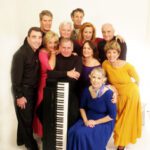
[Photo: Ross Commons Singers, 2001, last group I officially sang with; I’m second row, second from right]
After returning from India, the Middle East and Yugoslavia in late 1982, I had to regroup, get back to work, and start earning money to pay off the loans I’d taken out in order to take three months off. I couldn’t afford to take singing or any other music lessons.
I continued singing with different Sufi groups and teachers: the Turkish whirling dervish Sufis (Mevlevi’s), whose work was inspired by Mevlana Jelalludin Rumi, Vasheest Davenport, the Sufi teacher I’d traveled with, and most often a Sufi teacher in San Francisco, Jon Lewis (who years later read poetry at my wedding). In his group, I enjoyed most of all the improvising we did as a duet above the other singers’ voices, which took us all if not into ecstasy, then into states of deep love and openness for the group and humanity itself. I sang with him frequently for about fifteen years.
As my work with Vasheest tapered off, I began singing with a classical choir led by another Sufi teacher, Marjorie Mirhunnisa Douglass, who had considerable experience with Bay Area jazz and classical musicians. I carpooled with other Sufis to Berkeley, Oakland or Alameda for a few years in order to sing with her. We sang mostly for ourselves: Bach, Poulenc, Mozart, whatever mass took her fancy. Occasionally we sang for a wedding or other ceremony. She was great to work with, not a taskmaster but committed to perfect harmony and honoring the music. She also was a great wit (still is) and fun to spend time with.
Around this time, I also decided to broaden my social and musical horizons by joining an open community chorus in my town, San Rafael, the Mayflower Chorus, which had started as a casual group singing at a pub. That definitely cut down on my driving to sing. However, I soon saw that the old guard members got all the choice parts and solos, and the music was a bit simplistic compared to what I’d been doing. But I stuck with them for a while and happened to meet a boyfriend there. He introduced me to the West Marin Community Chorus and Orchestra (more driving, twenty-seven miles one-way over some serious hills to Bolinas on the coast), led by David Murray. We mostly did semi-annual concerts of classical or seasonal music, Easter and Christmas. Although anyone could join, we did some more demanding music than Mayflower had done. I managed to get a one-line solo. When I tried out for the part of Ado Annie in their production of “Oklahoma,” I got a chorus part, but turned it down because I felt it wasn’t worth it to increase my driving over those hills to several times a week to only sing in a chorus. Also, as is often true of local choruses, preference is given to people who live in their town or have been with the group for decades.
David took over another group, the Marin Rock and Roll Choir, when its director left. We had twelve people, so three in a section. This suited me, and I really liked the altos, with whom I had a good blend; all gals close to my own age (late 30’s, early 40’s). Sometimes we got a lead part, as altos might in rock ‘n’ roll, especially when we did Motown numbers: “I Can’t Help Myself” (Sugar Pie, Honey Bun), “Baby I Need Your Loving,” and “Reach Out, I’ll Be There” particularly. (The boyfriend was in this group as well.) We volunteered for fairs, retirement homes and other community events.
That was mostly a joyful group, partly because the soft rock music was so much fun to learn and perform, and when David moved to southern California in 1989, the directorship was taken over by George Wallace, a member of an accomplished brass quartet comedy group, The Brass Band, classically trained, which started in San Francisco nearly twenty years prior but also toured Australia and Europe. He was a serious musician with a wit and sense of humor but also brooked no nonsense. He knew more about stage presence than any of the other directors I had worked with, so our transitions were tighter and our connection with the audience, so important for rock music, became better-honed. We continued with him until the group broke up, as groups will do. (Additionally, I’d broken up with the boyfriend by 1991.) My favorite compliment from George was that the altos had the best audience relationship in the group: “Everybody loves the altos!” he said. He was not given to effusiveness, so I was happily stunned by this, but insisted that this was because the audience loved the numbers we did.
A year or two later one of the altos (who’d become a friend outside the group) told me George was directing a new group, called the Ross Commons Singers; they had named themselves after the park where they first sang and it stuck. Some of the singers were those who had been in the rock choir, and of course George knew my voice, but I still had to perform what was an audition so that the people who didn’t know me would get a sense of my voice. I remember being told by one of the men that I had surprisingly good breath control, which I had taken for granted. (Hat tip to the Sufi work and lessons from Judy Davis.)
In this group, we did a few of the soft rock numbers I already knew from the previous group (same director, same arrangements) and added several 1940’s jazzy numbers and a Christmas repertoire. We were doing the same “circuit,” local fairs, convalescent homes, and some volunteer gigs with a non-profit called Bread and Roses which provided entertainment for seniors and hospitals. A few years into this I had married and moved to the south of San Francisco, so once again I was commuting to sing. I had to commute to Marin anyway to keep my accounting clientele, so I’d have one night a week when I got home to San Mateo extremely late.
As the group evolved and our harmony improved, and we learned some really classy numbers (“I’ll Be Seeing You” was a beautiful favorite) and some silly light numbers like “Under the Sea” from the Disney movie “The Little Mermaid,” George’s Australian wife, Denise, who was an accomplished music teacher and had a lot of cabaret experience, began adding choreography and props to the numbers in order to give us more appeal on stage, and hopefully prepare us for some slightly paid gigs. This was a big challenge for me, as I already needed to sit on a stool part of the time for a long performance. (As polio survivors age, our lack of motor neurons causes us to begin to have increased weakness and fatigue, which was already an issue.)
In 2001, the group decided to do a big performance and rent a hall, and do a two-set show, with the active and upbeat numbers first, and the more sedate and beautiful songs in the second set. In the first set we wore different colored identical dresses and the men had colored shirts, and in the second, dressy black and sequin-studded apparel for the women, black shirts and nice ties for the men. Some of us sat on stools to sing and some stood in one place. We rehearsed more often and worked hard to create something that was worth selling tickets; members contacted everyone we knew. I think we charged about $20 per seat, and filled a small auditorium with one to two hundred people. This was in September 2001, a few days after the 9/11 attack happened. I think it’s fair to say that the audience was in a state of shock, and also glad to have a musical diversion.
The first set was fun and involved a great deal of moving around on stage. When the curtain closed, I could barely walk to the back of the stage to grab my cane and hobble down to the women’s stage restroom to change. My polio leg gave out and it was a bit scary. It was not just fortunate but imperative that I sat on a stool for the second set. A friend of twenty years told me afterward, “The first set didn’t do much for me, but the second set was beautiful.” And that was more or less my assessment as well, although the first set had some fun numbers. One of the altos said she felt like a dancing bear with all the new choreography. It was difficult for some who really were not that graceful or were aging, and to me looked sometimes a bit chaotic, although it was acceptable and lively from the audience’s point of view.
I was glad to have done the show but handed in my resignation at our next rehearsal. I just could not do the choreography. I also had been thinking for some time that I was tired of doing the same numbers for fifteen years, and the same type of music from the 1930’s and 40’s (some a decade or two later). I missed working with more accomplished and serious singers, as well. I had been thinking I would love to get into something like a trio of women with close harmony and possibly do some updated Celtic music. I got a couple of women with good voices together and we sang a few songs and agreed we sounded very good together, but none of us was an accomplished pianist or guitarist and we felt the lack of a take-charge member who could carry the instrumental and directional chops.
I did continue to sing and play my guitar for a few years, until arthritis began to make it so difficult and I lost the calluses on my fingertips as a result, making picking it up only on occasion not a rewarding experience.
I still like to sing along with CD’s or the radio, and in public places where everyone is singing, I’ll give it a shot at harmonizing and singing aloud. (Most recently at the county fair, where the Family Stone, minus Sly, blasted out their catchy, hooky danceable numbers.) But when one does not sing regularly, the vocal cords begin to get flabby like any muscle, and breath control and certainty of pitch begin to decrease. (You probably have noticed this in most aging rock stars. They usually can no longer hit the high notes, and their voices may have too much vibrato.) Every five or ten years, Allaudin, the director of the old Sufi Choir, will ask some of us to come in and record something he’d like to preserve and it’s fun to be a part of that beautiful music; I find that my reading off the page is not strong anymore, however, and my voice is weaker; I had to sing tenor in some parts a few years ago, as I couldn’t reliably hit all the higher alto notes clearly. Disappointing, but expected, and no one complained.
I’ve seen most of my favorite musical groups, and here I’ll drop some names. I went with friends, boyfriends and my current husband to so many venues: the Fillmore, huge outdoor rock concerts in the 1960’s (see prior blogs), the UC Berkeley Greek Theater (the Chambers Brothers, Leon Russell, Maria Muldaur, Pat Metheny, Bonnie Raitt, the Spin Doctors, David Byrne), San Francisco, Berkley, Oakland and San Jose venues (Keith Jarrett, Elton John, James Taylor and Carole King, Eric Clapton, Van Morrison, Bob Dylan, Mark Knopfler, the [Dixie] Chicks), the Grateful Dead, Emmy Lou Harris…) and we used to regularly attend the Bay Area’s Midsummer Mozart Festivals. We still do in years when they’re performing if we can. I am enthralled by Mozart’s music. We’ve been to classical string quartet concerts in Paris at Sainte Chappelle several times, as well as classical piano concerts at other Parisian churches and heard the Russian state orchestra in Colmar (a German city technically in France) and music festivals in California, Scotland and Ireland. We go out to hear groups we like here in Marin, especially if we can sit outdoors and have a bite while enjoying a local group. We go to Freight and Salvage, a venue and non-profit that I attended way back in 1969 when the bluegrass band lived with me; most recently we saw a Cape Breton Celtic group there, Le Vent du Nord. Great performers. I am fortunate that my husband agrees that music is an essential expense. I listen to CDs on our outdoor speakers when I do my pool workouts, which mostly are done while standing in the shallow end, so I can even sing while I do stretches.
In my teens and twenties, I was very much into art, drawing and painting. That fell off when I left art school, though occasionally I’ll do something artistic; I last did a watercolor about ten years ago. I was very much into singing with groups from age nine through my mid-50’s, and sang and played guitar (just basic rhythm) for nearly forty years, and wrote several songs, one of which was recorded. I started writing seriously, and published memoir, travelogue and historical fiction books after I semi-retired at age sixty-one. That’s been my primary creative endeavor ever since (as I write this, I am a young seventy-eight and a half).
But music will always feed my soul, even if I can no longer type, draw, or sing. I’m nowhere near done here on the planet and I’ll still do a little more singing. You can find me at a live music venue every once in a while; hopefully more than once a month. If you think I’m about to kick the bucket, please put on some soft Mozart, or maybe the second movement of Bach’s Concerto #5 in F Minor. After I go, please play “Into the Mystic” by Van Morrison. Here’s part of that great song:
“We were born before the wind…
Also younger than the sun…
[And later:]
“Let your soul and spirit fly
Into the Mystic.
Yeah, when that foghorn blows
I will be coming home.
Yeah, when that foghorn blows,
I wanna hear it,
I don’t have to fear it.
I wanna rock your gypsy soul
Just like way back in the days of old;
Then magically we will float
Into the Mystic.”
Leave A Comment