
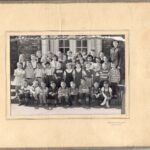
Kindergarten, I’m far left second row
My mother had a pretty voice and sang to me when I was a toddler. My dad whistled all the time, often “Anchors Aweigh”—he’d been in the US Navy in World War II—and had good pitch and a cheerful disposition. His father called him “The Canary.” We also had a record player from Mother’s first marriage, a big piece of 1930’s furniture, and my mom would put on 78rpm records from time to time, Glenn Miller big band, Strauss waltzes or whatever else she cared to listen to. We watched “The Hit Parade” when we got a television, and I soon was singing along to all the 1950’s songs: “How Much Is That Doggie in the Window?,” “You, You, You,” “That’s Amore” or “Mr. Sandman.” Fortunately, it wasn’t too much longer before we had rock and roll, with “Earth Angel” being one of the earliest rock ballads.
By first grade (1953), I was getting music lessons in school; we in northern California and possibly in many if not most parts of the United States still had subsidized music and art in school, for everyone. The songs we sang were old American classics, mostly; “Oh, Susanna,” “She’ll Be Comin’ around the Mountain.,” “I’ve Been Workin’ on the Railroad,” “My Country, ‘tis of Thee,” “America the Beautiful.”
Our music teacher, who came to our class every Friday from first through third or fourth grade, was Miss Allen. She was… well, not attractive. Very tall and heavy set, as we say to be polite, and a funny haircut; black with gray running through it, extremely short and very curly and it usually looked like it was wet. This wasn’t a flattering look as it made her head look like a ball on top of her substantial neck and body. She usually wore those nylon shirtwaist dresses that were popular at the time, in a dark color such as navy with tiny white polka dots. And her speech style and mannerisms were more masculine than the other teachers, or in fact most of the other women we’d encountered in our lives. So, one had to get past what she looked like to really pay attention. But she was truly knowledgeable and had a good singing voice, and we all looked forward to her classes on Fridays.
She taught us to read music. To actually read it, starting at age six or seven. To understand what a quarter note, a half note, and a whole note were, and what a scale was, and what the lines and spaces on the staff meant, and what their letters were. Starting from the bottom of the staff, “Every Good Boy Does Fine” were the lines, E, G, B, D, F. “FACE” for the spaces, F, A, C & E. I didn’t have to look that up, so that mnemonic device really did work. (I did have to look up what the word for that trick was, however.)
Then in fourth grade, we were invited to join the fourth and fifth graders’ elementary school chorus. (By this time, I was listening to rock and roll every night on the radio; 1956.) I don’t remember there being tryouts for chorus; I think the activity may have included everyone who wanted to sing in the group, but it certainly was not more than twenty percent of the nine- and ten-year-olds. Possibly, Miss Allen invited people who showed some musical ability; kids she knew could sing on key, for instance.
I don’t recall ever doing a performance, but it may be that we sang for things like holiday assemblies for the school. I’m sure Christmas carols would have been included in Miss Allen’s repertoire for all classes. I don’t think she continued to come into the fourth and fifth grade rooms weekly, so maybe she moved on and we had someone else leading the chorus. I am a bit frustrated that I can’t “see” who was leading us; it was definitely a woman.
Early in this era, when I was about seven, the neighbor woman next door, Mrs. Newton, offered to give me piano lessons; I don’t know if my mother paid her. We did not have a piano, so I had to go to her house to practice. My mother had had a piano when we’d lived in Los Angeles, but when our small family moved over four hundred miles north, my dad had not wanted to pay the $50.00 (about $640 in 2026 dollars) to ship the piano.
Then Mrs. Newton’s two daughters, who were a little younger than me—oh this was really a shame—got into our garage and took a can of the black tarry stuff used to seal off the ends of cut limbs on trees and smeared it around on their gray cement block fence. They of course got in trouble; their parents were furious, so they told them that I had done it. (The polio girl had taken the trouble to walk over to their house when they weren’t home, carrying stuff, and slop it onto their fence. Right.) Mrs. Newton came over, I answered the door, she grabbed me by the arm, accused me, and gave me quite an intense spanking. I cried out, telling her, and my mother, that I absolutely had had nothing to do with it, other than at some point showing them we had the stuff in our garage and wasn’t it a weird substance. Mother forbade me to ever go to their home again or to play with the two girls.
From the standpoint of musical hunger, this was a major disappointment, not to mention the betrayal by my friends and the loss of two frequent playmates.
The people across the street had a piano also, and they were fine with me practicing there… occasionally, but not daily… and the woman next door to them, Thelma Ashford, a widow like my mother, was a professional piano teacher. So, she taught me for a few months as well. I made it through perhaps two total years of lessons, but not having a piano was inconvenient, to say the least, both for me and for the neighbors.
Next: A piano substitute
I had piano in jr. high school. I seemed to really take to it; it almost came easily to me. I wish I had pursued it (somehow!)
I’ll bet you were good at it; your mom was musical. I had known she played cello as a teen, which is not at all easy, but I didn’t know until after she died that she’d also played piano. I regret that I didn’t go further with lessons also; I did attempt to teach myself again later in life; I have an electric keyboard but used it to learn parts for groups I sang with. I wanted to learn RnB but didn’t stick with practicing. I also have small hands, not great for piano; and when I started getting arthritis I gave up guitar. At least I had a lot of years of singing!