
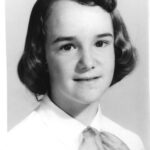
(Photo is insecure Francine at 12)
During the time I was taking piano lessons while practicing at neighbors’ homes (mid-to-late 1950‘s; see prior post), I was also trying to orchestrate little shows that I and the kids on our block might eventually put on for our parents and other children. I was partly inspired by the shows the children put on in “The Little Rascals” series. Darla was cute as a button, and I wanted to be like her. We had a big cement front porch that was covered by a roof and had the walls and windows of our living and dining rooms on two sides, and was open on the other two sides, one facing the street, and would make a perfect stage. I imagined our lawn with at least ten people seated on it watching us perform.
I was quite enamored with the actresses and singers I saw on television and particularly drawn to musicals; Fred Astaire and Ginger Rogers dancing to “Top Hat” while Fred sang was a big favorite. The TV stations still aired some of the Busby Berkeley movies as well, with a lot of gals dancing and kicking up their legs, along with the synchronized swimming of Esther Williams (whose name I couldn’t remember; thank you, Google).
It had become clear to me by the time I was nine or ten that I was destined to be a movie star, or maybe only a singer. I made up names that I was going to give to my first daughter when I grew up, became famous, and got married, one of which was Zjina Carol. (My first name is Carol; don’t ask me where I got the Zjina. I just liked it because it was exotic, I’m sure.)
But I never got far with my stage productions, although I did write parts of a couple of them out, enlisting a few kids to learn the parts, and made up a couple of forgettable songs. We never put on a show. When I was about eleven, I made up a song called “If;” the first line was “If—it’s a big word…” I think the gist of it was that “if” carried a lot of weight, if you did this, if you did that, if someone liked you, if they didn’t… but again I didn’t write it down. Just sang it near the fence in our back yard so the neighbors would hear me, as if that constituted an audience.
When I was eleven going on twelve, and not having a piano was putting a damper on my piano studies, my mother suggested getting an accordion and taking lessons, since the instrument at least had a keyboard. She researched where to get the lessons (a studio in Marysville, the town across the river from us in the Sacramento Valley) and looked into purchasing an accordion. We picked it out together, a candy apple red one with a faux quilted look finish which we both liked. It cost $375, which was a serious amount of money for my widowed mother to spend. That would be at least $4,000 in today’s dollars. I see now that the instrument was overpriced, and that my mother got fleeced. An accordion of that price today would be for a professional, and you can get a beginner’s accordion for about $450-$800, or about $40-$70 in 1958.
I took lessons every week and usually kept up my practice, but the accordion was far from the cachet and versatility of a piano. I did learn to play the simple versions of “Lady of Spain,” that classic accordion piece, and “Aloha Oe.” Mom and I were both sweet on Hawaii; we watched Hilo Hattie’s show every week and she thought I should learn to hula, thinking it didn’t take much leg strength, and you didn’t move around much. Decades later I realized that the hula takes a great deal of quad (thigh) strength, and you have to be able to put your bare foot down flat repeatedly which I could never do because I had a drop foot which was paralyzed (from polio, if you didn’t already know that from my other writing).
The accordion weighed a ton, and I could barely lift it, let alone walk with it. I had the thought more than once that even though it was portable, it was hardly a realistic instrument for a girl who was 4 feet 10 and had a paralyzed leg. But I stuck with it for a year and a half; then came the recital. I got as dolled up as I could in a dress with a black corduroy ruffle at the hem; I think it may have been a dark plaid… so this was probably in the winter… and we drove north about twenty-five miles to a little town called Gridley, which was even smaller than Yuba City. There was a small auditorium with a stage, and one by one each of us budding stars sat alone in the middle of it and played a musical number, after which the audience, all parents and family, politely applauded.
What impressed me about this recital, besides that I perspired so much that my bangs stuck to my forehead and my hands were slippery on the keys, was the other children who were mostly around my age. By this time, I was thirteen and in seventh grade. Checking out all the participants, I was mortified to notice that they were all, well, squares. Today you’d say nerds, geeks, or use a kinder term like socially inept pre-teens. And I didn’t see myself as being part of that group. Movie stars and famous singers just did not play the accordion. I mean, there was that one guy on Lawrence Welk, but what was cool about “The Lawrence Welk Show” was the Lennon Sisters. And they only sang, they didn’t play any instruments, and certainly not anything as unfeminine and uncool as the accordion.
So that did it, I put the instrument in the closet and never touched it after that until I moved out of my mother’s house at nineteen. She was understandably miffed after spending all that money. But I just couldn’t. (When I was thirty-five, I wanted to go on a three-month sojourn to India and the middle east, and sold the accordion for $125, about $400 in today’s value. So rather like 10% of what Mom had paid for it. I don’t think I told her what I got for it, but after hauling it around to the six places I had lived in over a dozen years, I was done with the lead weight of it. It was an approximate $900 value albatross of guilt.)
Next: Moving on to more serious music
Interesting story! I enjoyed reading it!
In the picture of you, you’re wearing what appears to be a Catholic uniform. Did you go to Holy Angels in YC? I don’t remember you attending Notre Dame in Marysville like my siblings and I did.
Nope, not a Catholic uniform. Interesting that you’d say that; I would not have thought of that! Just my 12-year-old idea of what looked nice in 6th grade for a photo. I was into using scarves to accent my outfits. And maybe my mother told me to wear a white blouse, I don’t remember. I do remember ironing the blue scarf! I thought it would add some interest to the plain white blouse. I was going to Gray Avenue middle school at that time, and prior to that I attended Bridge Street School from kindergarten through 5th grade. And then Yuba City Union High. Thanks for commenting! I always wonder if anybody is reading any of my stuff!
I remember you playing that accordion!
Ha ha… enforced family recitals. I’m sorry for your tender young ears.