
I want to back up a bit. In my last blog about middle school music, I said we’d move on to high school and rock and roll.
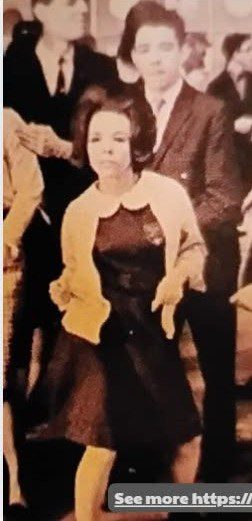
(Photo: Mighty Mouse of American Bandstand)
But my relationship with rock and roll, as I mentioned in Part I, began when I was seven or eight years old. I started listening to it on the radio about then. “Rock Around the Clock” by Bill Haley and His Comets, “Earth Angel” by the Penguins (had to look their name up), and “I Got a Woman” by Ray Charles was my starter set. 1956 brought “Why Do Fools Fall in Love?” by Frankie Lymon and the Teenagers. I loved that song and sang it with my best friend. This was also Elvis Presley’s debut year and seeing him on TV in the fall on “The Ed Sullivan Show” was quite an eye opener for that time, all that hip gyrating… but I was not taken with that so much as with his songs: “Don’t Be Cruel,” especially. Yeah, pretty grown-up themes for a second or third grader. I was definitely destined to be a romantic. (I remember having crushes on little boys at that age.)
Although I now know that Dick Clark’s TV show, “American Bandstand,” had started up in 1957, I was tuned in to a different bandstand, “Shan’s Bandstand,” a local Yuba City/Marysville, California radio show. There was a hamburger stand called Shan’s across the street from Bridge Street School, where I attended kindergarten through fifth grade, and in fourth or fifth grade we used to go over there after school and get a coke or maybe a really cheap burger if anyone had that much allowance money. (My mother took me there for us to get take-out sometimes.) When you bought something, you could get a request slip, printed on goldenrod colored paper, and request that specific songs be played and dedicated to someone. So, for instance, I could request that “All I Have to Do Is Dream” by the Everly Brothers be dedicated to George (Johnson, whom I had a crush on from fifth through twelfth grades) from Francine. Or that “Tan Shoes and Pink Shoelaces” be dedicated to my friend Janice (Bromley; we sang it for our class, with the requisite polka dot vests my mom made). These requests would all be read, no matter how many for a particular song, by Stan the Man, the Yuba City DJ who played the music we were dying to hear every night. And Shan’s got a lot of business and a lot of publicity out of the ingenious request scheme.
I think my American Bandstand era started in seventh grade, when I was commensurately singing in the middle school chorus (all pop and American classics, all the time, no rock). I’d rush home to watch it, sometimes at my older best friend’s house; she had three brothers and four of the siblings played instruments. The show aired in the after-school time slot all across the US, around 3:30pm. I think my friend Debbie Robinson introduced me to A.B.; she had lived in Pennsylvania, and her stepfather was with the US Air Force. (There was an air base about twenty-five miles from our town, and some of the officers moved into town, apparently so that their kids could go to better schools. Or possibly their wives preferred being in town where they’d have some kind of social life as well. I had two friends whose dads were stationed out at Beale, and as is true of other military kids, they were only around for a year or two.)
That’s about the time the Shirelles were on Bandstand, and I remember being deeply moved by their music, some of it in a minor key, always a hook for me. “Baby, It’s You,” and “Will You Love Me Tomorrow” (written by Carole King, yet to record her own version) were favorites, both of which I can still sing by heart. We still had the less ethnic (black) and less emotional songs of Bobby Rydell and Frankie Avalon at that point, probably more favored by our parents. Speaking of black, I recently learned that American Bandstand tried to keep their show “clean” by making the boys wear suits and ties (I always thought it was just that Philadelphia boys were sophisticated and always dressed up) and not allowing the original forms of the Twist, which had more suggestive hip movements that came out of the black neighborhoods of the Philadelphia community. Chubby Checker was invited to play (well, in reality, all the musicians lip-synced, they didn’t really play, which we were aware of)—but to tone down the movements he’d normally do… and black teenagers were by and large excluded from the white, mostly Italian American teenagers brought in to dance on the show. This practice was illegal but Dick Clark and the producers found ways around the law. I had not known this and didn’t notice it as a young white pre-teen in the Central Valley of California, where there were few black families. And we called them Negro then; “black” wasn’t in use until the late 60’s.
In any case, I loved their music. Barry Gordy founded Motown Records (in Detroit, in case that name wasn’t obvious) and here came the hits that defined my middle school days: “Money (That’s What I Want),” “Shop Around,” “Please Mr. Postman,”, “Do You Love Me?” all by black artists. If you remember any of these, or if you want to look them up on YouTube, you will notice that they are very, very danceable. And I was doing that, learning the dances they were doing on Bandstand and that kids who traveled were bringing back to our area. There was one gal nicknamed “Mighty Mouse” who was tiny and cute and did the Twist in a unique way, which my friend Debbie taught me. Mouse (real name Paula Kopicko) had hair styled in a flip which I tried to emulate starting in eighth grade. But mine was baby fine and hers was not so I looked wilted much of the time.
After entering high school, I was on the college prep track in accelerated classes, so with roughly five hours a night of homework and some every Saturday, I had little time for music, other than listening to it in the evenings on the radio while I did that homework… and going to the “teen dances” every weekend. The high school had some dances, usually after home games of football or basketball, but on the weekends the only other things available to do bsides go to a movie or the rare evening birthday party were to cruise town with a friend who had a car or access to a parent’s car; the route was to go by the bowling alley and see if any older kids’ cars were there and then drive a couple of miles to the A & W to have a root beer and see who drove through, or just drive through yourself if you didn’t have money for a drink and fries. And yes, they had car hops then. And then drive the whole loop again. Sometimes a small party would ensue. To alleviate the boredom of the rock loving youth, some civic minded person instituted the Saturday night teen dances. And that’s what we called them; it was either “Are you going to the teen dance?” or “Are you going to the dance Saturday?”
Some name bands came through our area; the Saturday dances were originally held at the National Guard Armory and then they were moved to a Quonset hut in Marysville, across the Feather River from Yuba City. I saw Paul Revere and the Raiders, We Five, The Turtles, the Beach Boys in our small burgs, and there are likely others I’ve forgotten. Our local bands were Freddie and the Statics (Freddie Bidasha, a young man of East Indian descent, one of the first Punjabis to become a rock musician) who were excellent musicians, and sometimes Drew Salee and the Dead; Drew was my age and was one of the first to dress in black, wear Beatle boots and drive a hearse for his band equipment. Drew still plays in our hometown area and had a career as a music teacher and musician.
In my senior year, most of my heaviest classes behind me, I finally had a little time to devote to music. I was invited to join a folk group for the Senior Follies, a variety show put on around the holidays. There were several of us in the group, maybe four guitar players and a couple of us just as singers; I played Tambourine. We called ourselves The Town Criers and were patterned very closely after The New Christy Minstrels. We were quite a hit and had done a lot of rehearsing for this show, thanks to our task master Terry Simons who insisted we get better and better. The surprise was that we started getting invitations to play other places, among them the Elks Club and the Country Club for ladies’ luncheons, so we stayed together for the whole senior year and rehearsed on a school night evening when we had a performance (a “gig”) coming up. Fortunately, in my last semester I was on the yearbook staff as the art editor, and the managing editor gave me almost nothing to do, which at first irritated me. So, the Town Criers could take off and perform, and I could miss lunch and yearbook class without much peril to my grades. I took up guitar a bit; my mother bought me a cheap Stella with such high action that it hurt my fingers a lot to play it. (I later purchased a Harmony which was slightly better and had better timbre.)
One of the English teachers, Mr. Hyman, originally from New York, and his teacher friend or girlfriend, Anna Hughes, also from New York, put together a hootenanny, a folk concert in the spring. The Town Criers were to be the highlight. But before that could happen, we had a mishap. One of our members, who’d been a friend of mine since kindergarten (will spare her name here) was a little drunk at our annual barn dance (on Sadie Hawkins Day, the one day per year when girls could wear pants instead of skirts to school, and we also were “allowed” to ask a boy to the dance). Our miscreant was suspended from going to any school activities for whatever time it was, a month or longer. So, we Town Criers went to the principal and said we wouldn’t play at the hootenanny (The main act! The big draw!) if she couldn’t sing with us. It wasn’t like she was only going for fun, as would have been the case for a dance or a basketball game, it was as a Musician! He held his ground, so we held ours.
We went to the show, without our friend, but we didn’t sing. A few people chanted “Town Criers!” and wanted us to go up but we said we couldn’t without our other member. Mr. Hyman, being a New Yorker with a keen sense of community, thought we did the right thing and made an example of us. So, music and social activism, however flimsy a cause we had in this instance, became one for me, for us. I had written my sophomore English term paper on Joan Baez’ music and made a black and white painting of a photo from one of her albums for art class (I had planned to become an artist; the folly of youth). Baez was at the time my favorite singer. As an alto, it was a bit hard for me to sing in her range, but I did learn to play some of the songs she sang on my guitar and my voice was probably higher then, than the range in which it landed in adulthood. But I was singing again and playing an instrument that was a lot easier to carry around than an accordion (see Part III).
Next: Leaf on the Wind
Leave A Comment