
 After high school I enrolled at San Jose State College (now University) where I had a tuition scholarship which was not worth much given the low price of state school tuition at that time. I could have gone to Stanford (youthful mistake in judgement), but San Jose had the best commercial art department I could find.
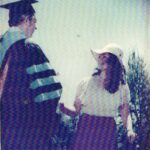
(Photo: Francine graduates in non-traditional attire with BA in Managerial Acctg much later, 1977)
It was a new world for me, adapting to—sort of—being on my own, living in a girls’ dorm on campus in a cramped room with another girl, learning to balance a checkbook and manage my scant funds. I was overwhelmed with classes, general ed and art, but found time to get out of the dorm (sophomore year: apartments, more freedom) and go to the local coffee house, Jonah’s Wail, to hear people play folk music and recite poetry. I had my guitar with me in the dorm and played it occasionally (all those Joan Baez songs; Vietnam was an all-encompassing issue at that time) but certainly would not have played any solos in public.
When I turned twenty-one, I purchased a Ford Econoline van with 30% of the small amount of money I had inherited from my dad’s death and used it to take my friends to rock concerts or to go camping or drive the three hours home to see my mom and friends. (I had the van for fourteen years, so I always felt it was a worthwhile investment, although I’m not sure my mother agreed.) Taking the Greyhound was not cutting it, and with a paralyzed leg, I could not do the amount of walking others could do; I had to have a car. At those concerts and in San Francisco (the Fillmore West) I saw a lot of the great mid-60’s groups: Jefferson Airplane, Big Brother and the Holding Company with Janis Joplin, the Youngbloods, Ravi Shankar, Cream… on and on. These concerts were very inexpensive but it’s possible my mother expected me to have zero entertainment. She had attended many dances with big bands as a girl; the difference was that she worked for her spending money and I inherited it, so I was expected to be frugal. Big difference.
After two years I transferred to California College of Arts and Crafts in Oakland, a better art school where I realized I was not as gifted as would have been optimal. I hung out sometimes with an older grad art student from my hometown who worked there (okay, he was my boyfriend as well, briefly) who was an excellent bluegrass musician and played with a small group called High Country. When I moved into a house during my second semester, Rich shared the place with me, along with his new girlfriend; cheap rent. And along with Rich came the bluegrass band, which was often challenging given they’d be there playing music into the wee hours, and I had school early in the mornings. I went to their gigs frequently, and we even took off and drove my van to Los Angeles one time because they got the urge to go visit the Dillards, a famous bluegrass group they were acquainted with and to whom I was introduced on very little sleep. But there was a lot of music in our house, and it was high quality, and I was motivated to keep playing my guitar, learning some folk, country, and country rock, even though bar chords were quite difficult for me.
I was running out of money from my small inheritance and knew I was going to have to quit school and find work. Rich also knew this was coming and one day he came home to our rental and said, “I found your guitar.” He knew that the one I had had too high an action and was tough for me to play with my small hands. “It’s a little Martin 0018 mahogany, and it’s only $200. It’s used, made in 1952, but it has really good sound and is a good guitar for a woman because of the size.” This was a lot of money for me to spend in 1969 (about $1,900 today) but I went to Lundberg’s music store in Berkeley, checked it out, fell in love, and bought it. I really appreciated that Rich had seen it and thought of me; that was the kind of love we had at that point, true friendship. And boy what a sweet guitar it was, as many who played it have told me over the years. I was now inspired to learn to play better and possibly be able to play and sing with others.
I quit school in June, with not enough money to make it through another year and feeling a little discouraged that I may not have been meant to be an artist, without knowing what I should be. My mother was furious.
I moved to Sonoma County, having gone there several times to visit old friends from home who had moved there, and I felt much more attuned to the country lifestyle than I had in the intense life of Oakland. I was never a city kid. I went into partnership with a woman who had a consignment clothing store in Forestville near the Russian River, and started sewing, which I can tell you is a tough way to make a living. I ended up taking over the store and never was able to support myself, but the good news was that I had time to learn to play that Martin better and I started writing songs. I met another top-notch musician on whom I had a crush (Okay, it was a pattern for a while) and learned a little from Josh (real name Rick, Josh was his “stage” name), and one of the songs I wrote, “Leaf on the Wind,” was about him. Following are the words of the first verse and the chorus:
“Came like a leaf on the wind,
Hitchhiking thumb on the highway.
Sage eyes wearing a grin,
Came by… to give me a day.
And the wind blows the leaf through my mind,
‘Cross the sky of my life he’s a-travelin.’
Caught up in his melodies fine,
On his strings… I can see… the truth shine.”
And it went on from there, to praise how music is an art which creates without leaving anything material behind; expressing the idealism of my youth. It had a lovely catchy tune, and a local group liked it and performed it. The fella liked it too and used to play it… and he floated on out on the wind, to Los Angeles, as I understood it.
I wrote other songs as well and spent much of my copious spare time doing that and playing occasionally with other people. Then I met my first husband, Bob, we bought a house, and I got a job and became a hausfrau, mostly playing music when people got together to party, and I’d usually be the least accomplished among them, although people liked my voice and I had a couple of numbers I could be counted on to play when the more skilled folks took a break. Bob had friends who were professional musicians and I probably played in their presence only once after I saw and heard how good they were. They were Bill Graham’s sound engineers for a while.
I left Bob after five years because he was a heavy drinker, and his being almost twenty years older did not help our relationship, either. Then came more songs, about losing love and looking for it. Lots of them. I went back to school and spent two years getting a BA in accounting, working 20 to 40 hours a week and taking an exceptionally full unit load to facilitate getting out and getting a job. (My mom was still pissed that I hadn’t gotten the art degree, “misusing” my dad’s death money, and my sister had to talk her into coming to my graduation [see photo].)
In order to fit in playing music and get some creative time, I took an elective called Expressive Arts, and wrote several songs and some poetry in that class, and spent more time with the people in that department than in the accounting department. ExArts had an assembly on Fridays when people presented what they were doing, and near the end of the last semester, I performed about four of my songs to applause and accolades. They were good, but the department was also very encouraging so I am not saying I was any Carole King. During that time I also got into a spiritual group based in eastern mysticism which had music as a key part of their philosophy and tradition. This is when music became a spiritual practice for me.
Next: Music as prayer
Leave A Comment