
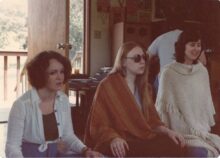
 In the fall of 1978, I began driving the seventeen miles from the communal Sufi house in Petaluma, CA to Sebastopol every Sunday morning, over winding country roads through Sonoma County’s peaceful bucolic scenery, to meet with eleven other singers and our director for the Sufi Choir, Allaudin (Bill) Mathieu. He had a music studio housing his grand piano with room for all of us to sit in a semi-circle on the floor, on a small hill a little above the home where he lived with his wife and three teenagers.
[Photo: Francine with Sufi Choir altos, 1980]
Our first lessons were focused on listening to each other and to the exact—and I do mean exact—pitch of the note. Some singers found this practice easier than others, but we’d all passed the initial test of being able to match a note on the piano pretty closely. Within this, we were exhorted to be sure that we could hear the other two voices in our section, so that we sounded as much as possible like one voice, with three different characters, with no one voice louder than the others. This was not about singing out, singing loud, standing out, but about attaining a perfect blend. When we did find that, the feeling could be close to ecstasy, and I sometimes got chills when it truly was perfect. I also felt a deep sense of oneness with my alto choir sisters in those moments, a welcome consequence.
East Indian vocal practices were employed nearly every week, and most of us already had some limited familiarity with those, having sung some eastern musical scales with other teachers either at the annual Sufi summer camp or in individual lessons. I did take eastern Indian vocal lessons with another teacher, to improve my pitch and tone and learn the basic eastern scale. One of my housemates who had a clear soprano voice and was also in the choir had a tamboura, a four-stringed instrument used for east Indian singing practice and performances, which was very useful in improving pitch. She would let me borrow the instrument as a drone to practice. I also took western voice lessons from Vasheest Davenport, the man I mentioned who had the “tenor to die for” on that first Sufi Choir record I’d heard in Ukiah a few years before… the one about whom I’d said on that day, “I want to sing with this guy.” And so, it had come to pass. I also started singing with him at his chanting classes once a week in Marin County, and he was soon having me help lead the women singers in beautiful contrapuntal choral chants, the purpose of which was to aspire to unity with the Divine.
Allaudin had written copious scores of music for the prior Sufi Choir, so we set about learning some of those songs, preparing some beloved by Allaudin and some beloved by people familiar with the choir’s music, and some by this new choir. And thus, we got to know each other (even more during our potluck lunch breaks) while rehearsing and practicing from ten o’clock to four o’clock every Sunday—every Sunday—from September through June for four years, with extra rehearsals added when we had a performance (a gig) coming up.
When we practiced, Allaudin, even with impaired hearing in one ear, could hear if one of us twelve were off key. He’d stop us, play the chord we’d offended, quickly play each of its notes and ask us to sing it again. Then if someone was still off, he’d go to each section asking us to sing our note together; then if he still heard a flat (usually) or sharp (sometimes) note he’d have each of us sing the note solo, a capella. When he found the person who was off, he’d have us sing it until we hit it right and suggest we practice it at home. That’s when those east Indian drone practices came in handy. (We were admonished more than once to be silent while the others sang, reminding me of my eighth-grade chorus and getting chastised for chatting. Choirs are a social lot, and it’s not always easy to remain silent for long periods of time while waiting to work on a part.)
Allaudin wanted to create a new album of music based upon the poetry of Kabir, an east Indian Muslim mystic who lived in the 1400-1500’s, as translated by the Minnesotan poet Robert Bly. We were each to take a poem and set it to music, if we chose to do so.The poem I chose began,
“It is time to put up a love swing.
Tie the body, and then tie the mind,
So they swing between the arms of the beloved.”
The beloved in this context is God, and giving oneself up to love for the Divine, but loving another human could be the inspiration as well. In Sufism, there’s little separation between the two forms. (Okay, I know that tying the body so it swings could have other meanings, but I promise you this never crossed my mind until it was pointed out to me decades later. I’d been requested to sing it at a memorial service and afterward a gentleman in the congregation stepped up and asked me with a chuckle if it was about that kind of “love swing.” I was a bit mortified.) I set most of the poem to music, changing the lyrics a bit to fit the music that came to me, and adding a verse, and calling it “Love Swing.” This was my solo whenever we performed, with the choir having a large presence in the song, of course. I was told, again years later, that it had a country feel, although I’d heard it in my head as a gospel number. When Allaudin first created the arrangement and had the choir rehearse it, I was surprised at how produced it was, almost apropos of a Broadway musical, and when he asked me if I liked it, I answered, “Well, I thought it was going to be gospel…” and he responded, “I thought this was gospel!” He was from a jazz background, and I was from folk music and rock, and we sort of met in the middle, with a big lean toward jazz. After a concert once, someone approached me and said, “I didn’t know you were a blues singer!” So, perception is definitely in the ear of the beholder.
We created an album, “Kabir” by the Sufi Choir, and performed the music in many venues in northern California: fairs, churches, small auditoriums. The ticket sales paid for travel expenses for the thirteen of us (in other words, if you had a car, you got gas money) and those of our sound equipment roadies if any (well, maybe some of them were also getting a small stipend, I don’t know), and we slept on a lot of floors in a lot of Sufis’ homes. Sometimes we were really good, and sometimes we were just okay, and sometimes there was a gig where we weren’t so hot and we’d talk about it afterward. If something went really wrong and we had more than one gig in a weekend we’d be rehearsing the particular sections before the next performance. We did perform with Robert Bly once at the Unitarian church in San Fransico; he read poetry and we sang the work we’d written based on his translations of Kabir. When asked how he liked the music, he replied that he didn’t. That was a blow, but we felt we’d done a sincere interpretation of the poems. We also sang with some famous new age musicians at Hearst Theater in San Francisco and I’m embarrassed to admit I can’t remember their names. Might have been Paul Winter.
We were expected to know a body of work by heart. A performance was often two half-hour to forty-five minute sets, or one set of an hour, so that a full performance might entail a couple of hours including the mid-point break. We never used sheet music at performances and sang as popular musicians who seek to connect with their audiences, with eye contact and emotive, inspiring lyrics and melodies.
Joining the Sufi Choir was one of the biggest commitments I ever made aside from marriage or work. Nearly all of us kept full time jobs while we adhered to this rehearsal, home practice, and performance schedule for nine months of each year, plus occasional performances in the summer. For me, given I was working for a CPA for the first year and then started my own tax and bookkeeping service, with very long hours from January through April, and living in the Sufi commune and going to several classes each week, this was my first and almost exclusive love. I didn’t have time for a relationship in those years, though I longed for one and did some infrequent dating.
After we’d recorded the album and done significant performing, which was very rewarding but also helped sell the albums (on vinyl in those days), Allaudin let us know that we’d mostly fulfilled the purpose he’d had for us. He did occasionally call some of us in to record other music he wrote, and he took on professionally directing a chorus in a nearby town in Sonoma County.
His advice to me was to take voice lessons with a woman who taught in Oakland, Judy Davis, who was Barbra Streisand’s west coast vocal coach, I later learned. Allaudin said I had a voice for rhythm and blues (cuz, alto) and that he felt I could go further as a professional if I wanted it badly enough. I had to send an audition tape, singing and recording on my boom box one piece I’d written and another that was mainstream, perhaps a Linda Ronstadt number, and nervously awaited the acceptance I was relieved to receive. She said I definitely had potential to be professional, and she only took people who qualified in that way for the group classes she held once a week. I was on to the next phase of music lessons.
Next: More music as prayer while learning pop with pros
Leave A Comment